
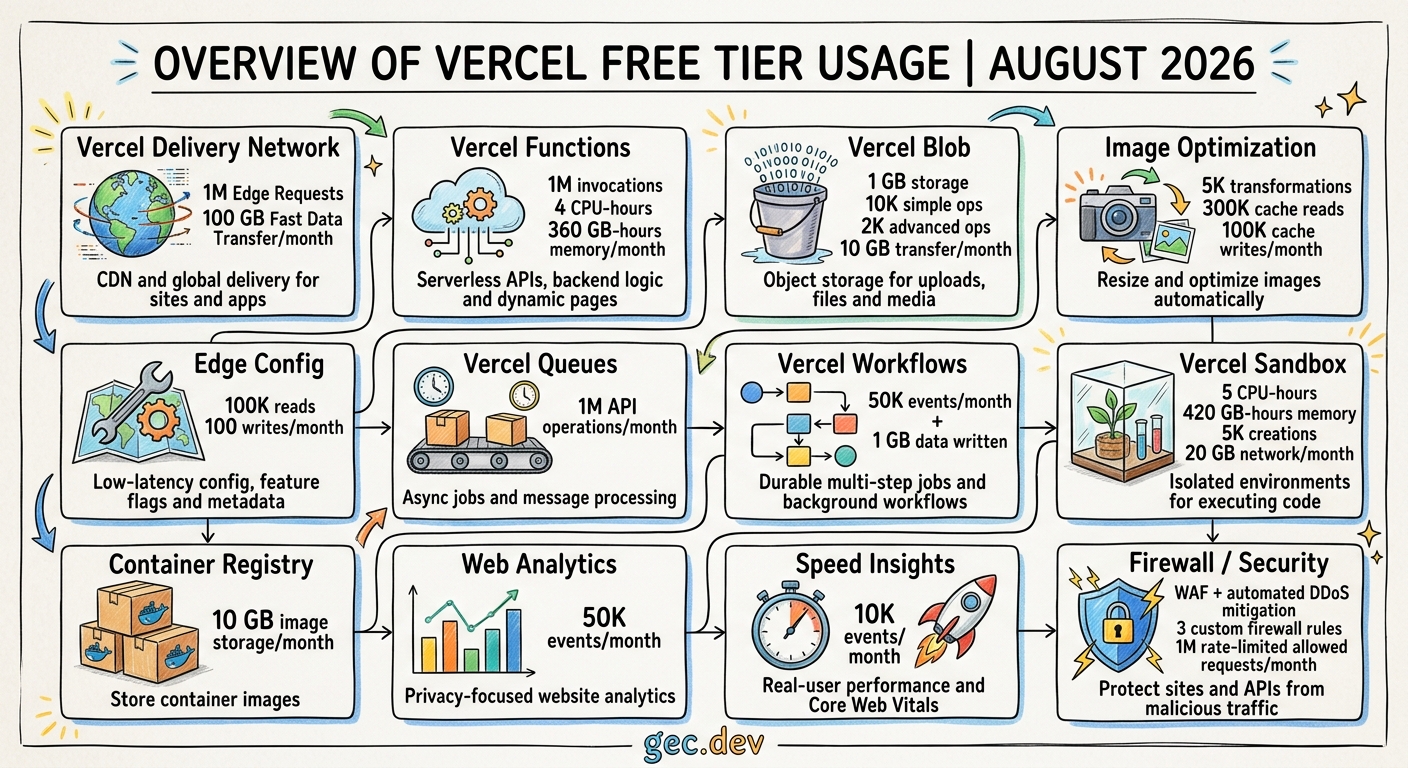
The Vercel free tier is more than a place to deploy a frontend. The image above is a snapshot of its August 2026 allowances, arranged by the job each service does.
Delivering a site
The Vercel Delivery Network sits at the front of the system. It distributes sites and applications globally, with the illustrated allowance showing one million edge requests and 100 GB of fast data transfer per month. Image Optimization complements delivery by resizing and caching images rather than asking every visitor to download the original asset.
For application logic, Vercel Functions run serverless APIs and dynamic pages. The guide records one million invocations, four CPU-hours, and 360 GB-hours of memory each month. These limits measure different constraints, so a workload can exhaust compute before it exhausts requests.
Data and background work
Vercel Blob provides object storage for uploads, files, and media. Edge Config is aimed at small, frequently read values such as feature flags and configuration. They solve different problems: Blob holds objects, while Edge Config puts compact configuration close to users.
Queues and Workflows cover asynchronous work. A queue buffers messages for later processing; a workflow coordinates several durable steps and can retain data between them. The illustration also includes Sandbox for isolated code execution and Container Registry for storing container images.
Observe and protect
Web Analytics gives privacy-focused traffic reporting, while Speed Insights records real-user performance and Core Web Vitals. The firewall layer adds WAF rules, rate limiting, and automated DDoS mitigation.
Treat every number in the image as a dated reference, not a permanent contract. Check Vercel's current pricing page before designing around an allowance.