
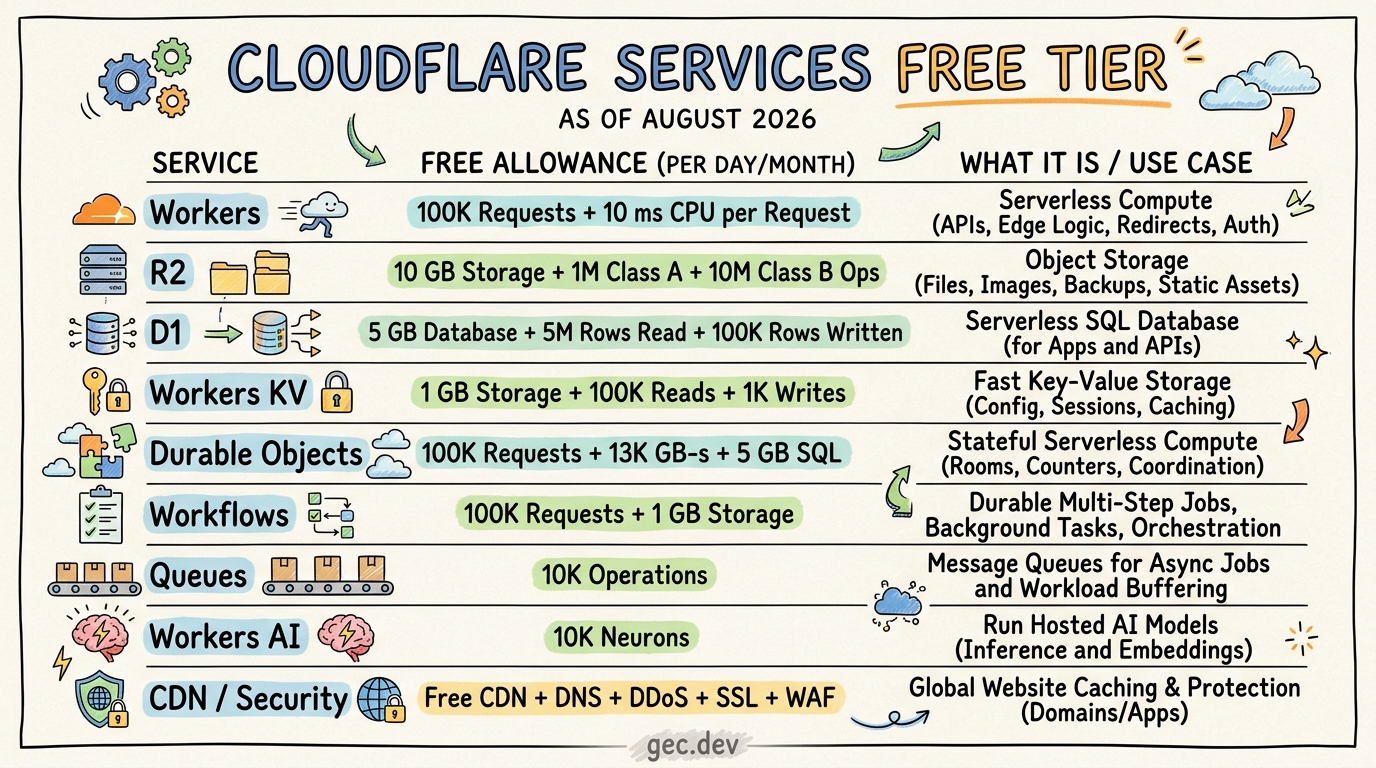
Cloudflare's developer platform combines code, data, and network services. The image groups the August 2026 free allowances by service and gives each one a plain-language use case.
Compute and coordination
Workers run serverless code near users. They are useful for APIs, redirects, authentication, and edge logic. The illustrated free plan includes 100,000 requests per day with a CPU-time limit per request.
Durable Objects add a stateful coordinator when many requests need to agree on one answer. Workflows coordinate durable multi-step jobs, while Queues absorb bursts and let consumers process messages asynchronously. These tools overlap less than their names suggest: Objects coordinate shared state, Workflows remember execution steps, and Queues buffer independent units of work.
Choosing storage
R2 is object storage for files, images, backups, and static assets. D1 is a serverless SQL database for relational application data. Workers KV is globally distributed key-value storage suited to configuration, sessions, and caching where extremely fast reads matter more than immediate consistency.
The free allowances in the illustration are expressed differently for each product: stored gigabytes, operation classes, rows read or written, or requests. Compare a product's billing unit with your access pattern rather than comparing headline numbers directly.
Network and AI services
Workers AI runs hosted models for inference and embeddings. Cloudflare's CDN and security services provide DNS, caching, SSL, DDoS protection, and a web application firewall at the network edge.
The platform and its pricing change over time. Use this image as an orientation map, then confirm current limits in Cloudflare's official documentation before shipping.