
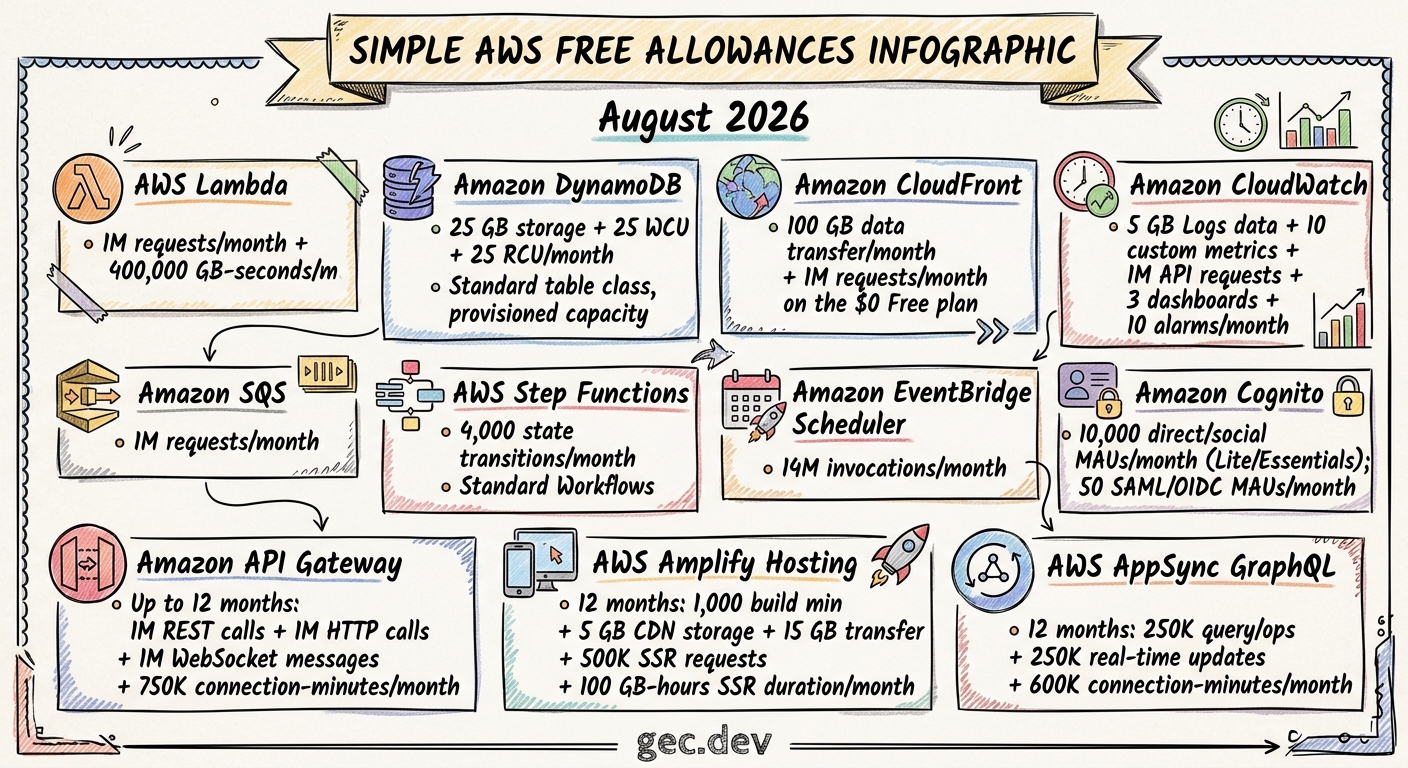
AWS free usage is spread across many services and measured in different units. The image is an August 2026 orientation map for a small event-driven web application, not a promise that every workload will cost nothing.
Request-driven compute and APIs
AWS Lambda runs code in response to requests and events. Its allowance combines a request count with GB-seconds, so both invocation volume and allocated memory duration affect usage. API Gateway provides managed HTTP, REST, and WebSocket entry points, while AppSync offers managed GraphQL queries and real-time updates.
Amplify Hosting covers a different layer: building, serving, and rendering a web application. The illustration separates build minutes, CDN storage and transfer, server-side rendered requests, and SSR duration.
Data, messaging, and workflows
DynamoDB is the database in the diagram. Its free allowance uses storage plus read and write capacity units under the provisioned standard table class.
SQS buffers asynchronous messages. Step Functions coordinates multi-step workflows and charges by state transition for standard workflows. EventBridge Scheduler invokes work at a chosen time or interval. Together they support systems where an incoming request can enqueue work, start an orchestration, or schedule a future action.
Delivery, identity, and operations
CloudFront delivers cached content through a global CDN. Cognito provides direct, social, SAML, and OIDC sign-in allowances measured in monthly active users. CloudWatch collects logs and custom metrics and supplies dashboards, alarms, and API access for observing a system.
Some AWS offers are ongoing, while others only apply for the first 12 months or through a specific free plan. Confirm the current region, account age, service tier, and pricing dimensions before relying on any number shown here.